

Evergreen Uprooted
CHAPTER TWO

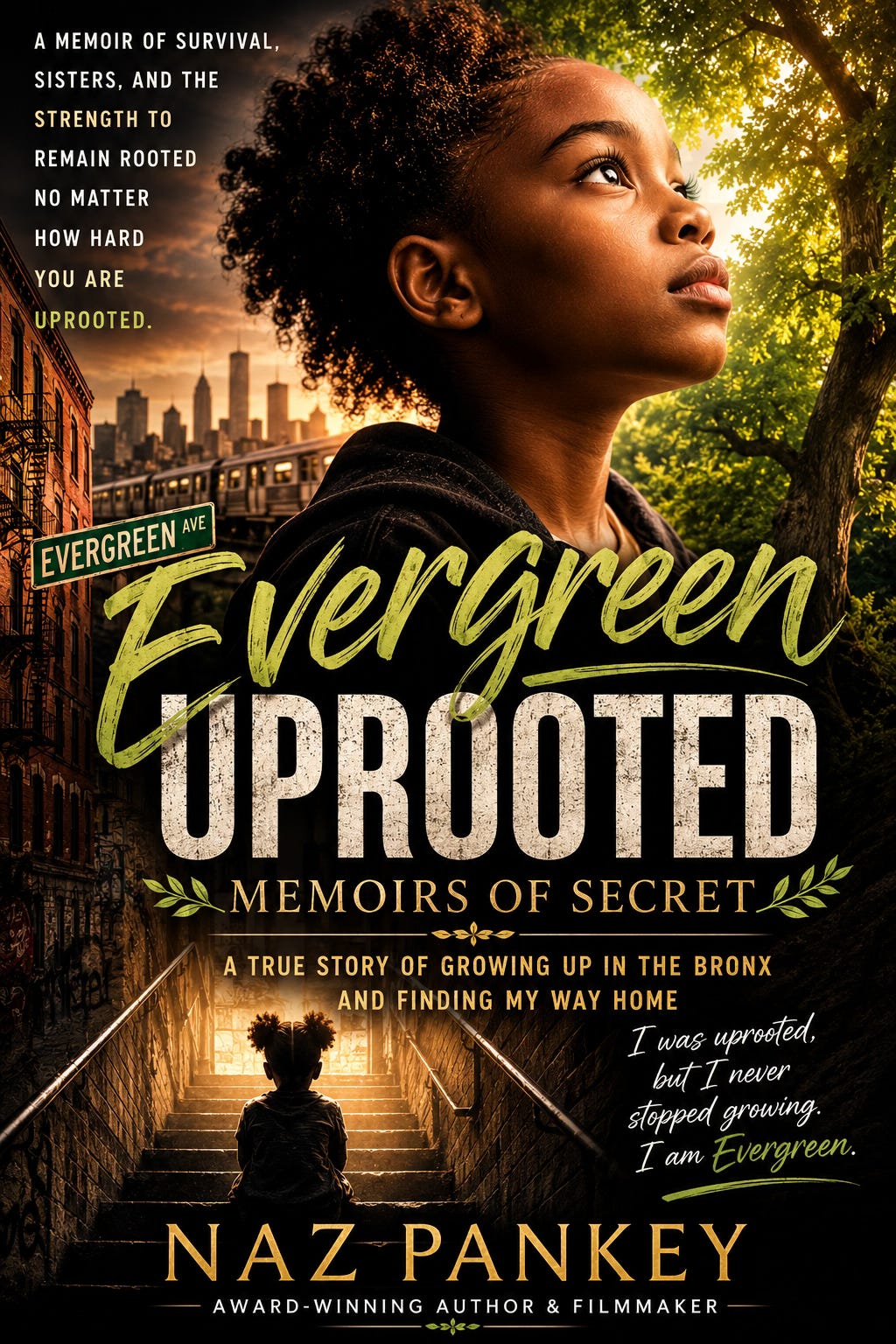
I wrote this book years ago as a single mother in college with a third-grade reading level and a high school diploma. I was in remedial reading at the lowest level, and it took me a year and a half before I could take college classes. During that time, I wrote Evergreen Uprooted, Memoirs of Secret. With the help of the reading and writing lab and my professors, this book was born. Also, I had a small community of friends cheering me on. I had no idea what I was doing other than purging, but it was in remedial reading that I found my love for writing and storytelling. I was inspired to share chapters of my book by Story Summit‘s VIP Special guest, THE LIGHT HOUSE w/Joel Fotinos — publisher, author, speaker, and minister.
This is the second chapter of Evergreen Uprooted, Memoirs of Secret. Please let me know what you think.


For he shall be as a tree planted by the waters, and that spreadeth out her roots by the river, and shall not see when heat cometh, but her leaf shall be green; and shall not be careful in the year of drought, neither shall cease from yielding fruit.
Jeremiah 17:8
I grew up in the birthplace of hip-hop music and culture: the Bronx, New York. During the early eighties I lived in the South Bronx on Evergreen Avenue, right off Westchester Avenue. Above the street sign ―Evergreen was the number six train line. It seemed like all the bodegas, ―corner stores as those in the neighborhood called them, were in competition. The bodega that was located across the street from my building, right at the corner, had neon lights that read ―LOTTO. Across the street was another store, with the words ―Grocery Store written in graffiti. Parallel to that was another store that contained very few groceries. Stores such as those were usually cover-ups for drug trafficking. In the next block over, there was yet another bodega, which had a portrait of a madman sprayed on the face of the building. The picture reminded me of the Joker in a deck of playing cards.


The South Bronx was home to many underprivileged people. Parks, pools, and community centers were nonexistent in my hood. So for the people living there, especially the poor, it was all about finding ways to laugh and have fun.
In the summer, we looked forward to opening the fire hydrant – we called it ―the pump. We flooded the street with water. No one cared that the pump was supposed to be used to put out fires. The young boys wore ripped jeans turned into shorts and were shirtless, revealing their skinny hairless chests. They made a hose by cutting off both ends of a soup can and attaching the remaining cylinder to the flowing water. They used it to spray the vehicles as they drove by. We called it ―the car wash. The OGs (Original Gangsters), respected men of the community who sold illegal drugs and made a lot of money, drove through my block in expensive SUVs and luxury cars, blasting the latest hip-hop songs, with smiles on their faces. Everything about an OG was glamorous – from the fresh waxed paint on their vehicles, to the thousand-dollar rims and tinted windows and leather interiors, to their tailor-made suits worn with shoes that shined brighter than Mr. Clean‘s bald head. I watched the OGs lean back, nod their heads to the music, and roll their tinted windows up for the car wash. One by one they slowly drove by and watched the excitement on the young boys‘ faces as they sprayed the water. The water looked like diamonds rolling off their vehicles. Imagine that: diamonds in the hood. It was like a scene from the movie Cinderella, unrealistic but not impossible. Every young boy that was living in poverty wanted to be an OG someday, and every girl wanted to marry one. Judging by the satisfied look in the OGs‘ eyes, giving the young boys something to do made them feel justified about polluting the streets with drugs.
I watched teenage boys throw young girls over their shoulders. The girls would be kicking and screaming while the boys tossed them into the brisk cold water that violently shot out the pump. No one stopped us, because no one paid attention to what was going on in the ghetto. A little further down the block, near the bodega, the guys crowded around and shot dice. I had fun watching them crack jokes and snap on each other while gambling for a few bucks.
Someone always had their radio in the window, turned up to its loudest capacity, playing the hottest hits from radio stations like KISS and WBLS. Hanging out on Evergreen was like being in a club and hearing the DJ play your favorite songs.
I recall jumping rope outside and playing hopscotch while hearing “It Takes Two” by Rob Base coming from someone’s window at one end of the block and at the other end, “This is Something for the Radio” by Biz Mark, coming from someone’s car. Being part of the ghetto gave me a rush, a feeling of excitement. The streets and I became one. I stayed out all day and night, until around four or five o’clock in the morning. When there was no one else to hang out with, I went home.
I hated going home. Going home meant that I might observe Mommy coming down off drugs. When I walked through the door, I did my usual lockup. This meant to lock the top lock, lash the chain, and lastly slide the long police pole, which was a special lock used for victims of domestic violence. Every time I slid that pole into its groove, it reminded me of the time this strange-man knocked on our door and tried to break in.
I will post a chapter or part of a chapter every week. If you’d like to read the book, you can order it on Amazon Click here.
I never got the chance to see his face. Mommy cracked the door open and he tried to push his way into our apartment. Mommy, my sister Naomi, and I tried to push the door shut. The strange-man shoved his hands between the cracks of the door to prevent us from shutting him out. We pushed the door, squashing his wrists and hands. He pulled his hands out and we slammed our door shut. Mommy quickly locked the door, and put the chain on it.
Then she called the cops. The cops gave her the long steel police-pole, which was placed into a hole that was drilled into our hardwood floor and pushed into a special lock attached to the door.
As soon as I walked in and turned on the hallway lights, roaches would scatter everywhere. The first room I passed was the kitchen, which was to my left. Because its shape was long and narrow, Mommy could only fit a rectangular table. The table had black plastic legs and a white top, with two black chairs to match. There weren‘t any pictures on the walls, just dirt and grease stains. I dared not go in there because if I did, I’d itch all night long. I‘d keep the feeling of roaches dropping off the ceiling, all over my skin and hair. Going in the kitchen at night was a big NO! NO! Besides, there was never anything in there to eat.
After walking past the kitchen, using the distant dimmed light from the hallway to see, I would tiptoe on the squeaky hardwood floors until I reached the cluttered boxes filled with second-hand clothing and all sorts of junk mail. When I reached those boxes, I knew I was at the living room. I would stand at the door of the living room, which had been transformed into Mommy‘s bedroom, and strain in the dark to see if she was home. My eyes always landed on her dresser first. She had enough medicine bottles on her dresser to supply a pediatric clinic. She had albuterol, nebulizers, pain reliever and fever reducer, amoxicillin, penicillin, calamine lotion, ringworm solution, chicken pox medicine, corn starch, diaper-rash ointment, A&D ointment, and empty methadone bottles that she had obtained from her drug rehab at the Lee Building in Harlem, with a little bit of orange juice mixed with methadone at the bottom. I have to admit I was often tempted to drink it, after being outside all day and having only water.
Her vanity display consisted of an eye-pencil, and a lipstick tube that was always half empty because it served as her lipstick, blush, and eye shadow. She used her pinky finger to dig it out. Next I would look at her many pocketbooks, filled with old food-stamp book backs and empty pill bottles. These hung down from the edge of the mirror that was located in the middle of the dresser.
Then I would notice that, as usual, she wasn‘t home.
Many nights I longed to take a bath after being outside all day, but most of the time the tub was overflowing with dirty clothes. Mommy would begin to wash the clothes by hand but would never finish. The laundry would sit there for days, creating a stench that filled the whole house, smelling like mildew and rotten fish mixed together. The clothes appeared to be floating on top of a dirty swamp with worms forming from the dampness.
The only lights that we had in our apartment were placed in the hallway, kitchen, and bathroom. We usually kept the bathroom door closed, because of the regular funk we were seeking to avoid. The apartment was always dark and depressing. My eyes were accustomed to seeing in the dark. So I would just go straight to me and my sisters’ bedroom, climb in bed, and sleep – on sheets that were changed maybe six times a year.
The four walls in our room contained dirty footprints and magazine posters. The windows were decorated with sheets instead of curtains. I could look out our window and see the whole block. The dawning of a new day on the streets provided an escape from a dark and hopeless situation.
I will post a chapter or part of a chapter every week. If you’d like to read the book, you can order it on Amazon Click here.
I am a proud member or Story Summit and the Okoboji Writers and Songwriters Column.
Your writing is so evocative, Naz, and you have an amazing story. I always feel like I'm right there with you, watching over your shoulder., waiting to see what happens next. And I love the cover of the book!